BUCHAREST — Călin Gogoșescu, the former presidential candidate held in pre-trial detention over an alleged €1.1 million fraud, has offered the staff of the Bucharest police detention centre a €6 million line of credit from a Swiss bank, and has accepted the centre’s coffee machine as a guarantee, according to a complaint filed by the officers’ union on Friday.
The arrangement, which was later extended to €15 million in exchange for a microwave, has raised questions about whether prosecutors can open a second case into conduct that resembles, in almost every particular, the first.
Mr Gogoșescu has been in custody since the Bucharest Court of Appeal ordered his pre-trial detention for 30 days on Tuesday. Prosecutors from DIICOT, the organised crime directorate, allege that he and a business associate persuaded a businessman from Buzău to pay more than €1.1 million as a guarantee for a Swiss bank loan of €6 million, later said to be rising to €15 million, which never arrived. Prosecutors have also placed a precautionary seizure on his house in Mogoșoaia, just outside Bucharest. He has not been convicted of any offence.
A modest prospectus
According to the union’s complaint, Mr Gogoșescu asked on Wednesday evening to speak to the shift supervisor about what he called “the state of the canteen”. The supervisor, who had expected a complaint about the soup, was instead shown a single page of handwritten projections on paper torn from a regulation logbook.
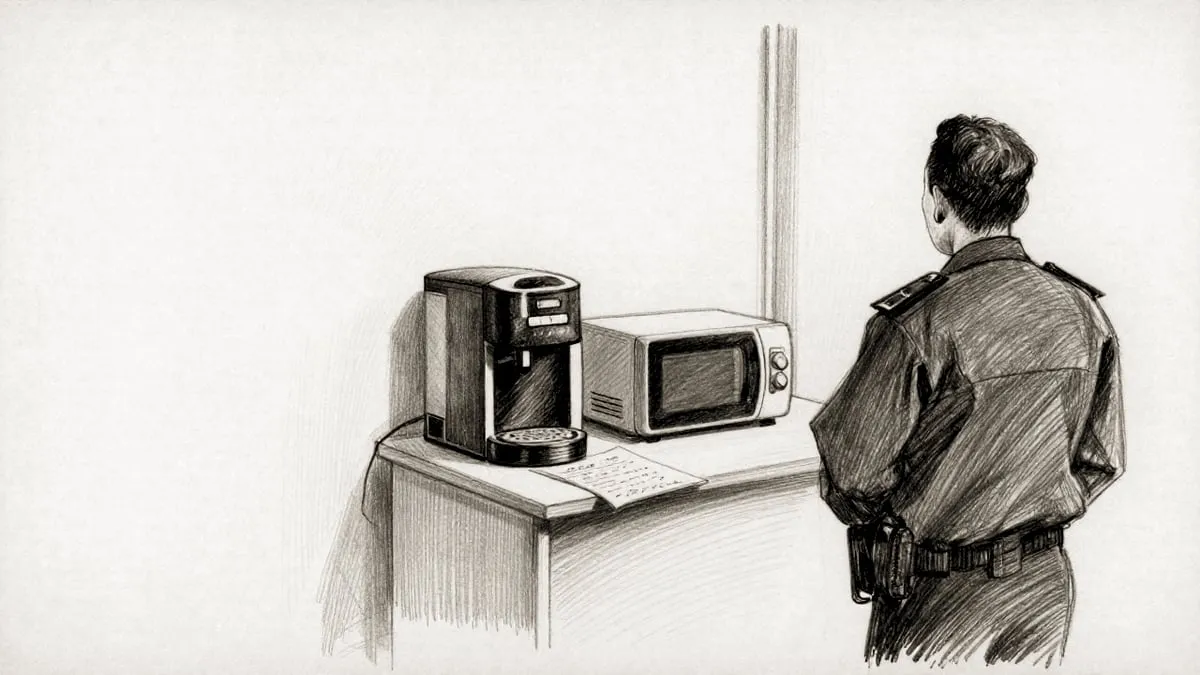
The page set out a €6 million facility from a Swiss bank, which it did not name “for reasons of discretion”, to fund a new canteen, a gym and a small sauna described as “energetic”. The only condition was a guarantee, to be lodged in advance, of “an asset of real value to the institution”. After some discussion among the night shift, the asset chosen was the coffee machine on the second floor.
It was, by several accounts, Mr Gogoșescu’s own suggestion. He told the officers that the municipal water supply had for some time been carrying microchips, that a machine which concentrated the water into espresso was concentrating the chips as well, and that such a device was “a strategic asset which should not remain in the hands of the system”. Two officers said they had never thought about it that way. One said he still hadn’t.
It was handed over at 9:40pm on Wednesday. The union’s complaint records that it was carried to the detainee’s cell by two officers, that it was still warm, and that a receipt was issued in pencil. Before signing it, Mr Gogoșescu crossed himself three times, and once more after reading it.
“He was very calm about it,” said one officer, a man in his forties who asked not to be named because he had not been authorised to speak and had not yet told his wife. “He explained that the coffee machine was not being taken away, only immobilised in a position of trust. He said the Swiss are very particular about collateral. Then he said a short prayer over it and asked whether it did cappuccino. It was the end of a long shift.”
From six to fifteen
On Thursday morning, Mr Gogoșescu informed the day shift that the bank had reviewed the application favourably and was prepared to raise the facility to €15 million, enough for “a swimming pool, a library and a hall for national gatherings”, provided a further guarantee was lodged. The microwave from the officers’ rest room was delivered to his cell at 11:15am. He accepted it on condition that it first be blessed, on the grounds that it emitted “frequencies of a foreign character”. The detention centre’s chaplain was not on duty, so he blessed it himself.
By Thursday afternoon, officers on both floors had no coffee and no means of heating their lunch, and no money had arrived from Switzerland. Officers on the second floor reported hearing the coffee machine in use, twice, from inside the cell. A message was passed to the detainee asking for a date. The reply, according to the complaint, said that the funds were “in transit through the proper channels” and that the delay was “a sign of seriousness”. When the day shift asked for further security, he offered his house in Mogoșoaia, which he described as “already held by the state, and therefore extremely safe”.
Adrian Costache, a spokesman for the National Union of Detention Officers, said the union had filed its complaint “with regret and without coffee”. “Our members acted in good faith,” he said. “They believed they were investing in the future of the institution. They now have a future without a microwave, which is a different thing.”
“He explained that the coffee machine was not being taken away, only immobilised in a position of trust.”
Mr Gogoșescu’s lawyer, Tudor Mălăescu, said his client had committed no offence and had merely been “offering financial education to public servants”. “Nobody was forced to hand over a coffee machine,” he said. “The microwave was offered voluntarily. As for the coffee, my client was testing the water for chips, at considerable personal risk, on behalf of the officers. My client regards both as being in safe keeping, and both are in his cell, which is the safest place in the building.”
The Swiss connection
DIICOT said only that it had “taken note” of the union’s complaint and was examining whether the facts amounted to a new offence or “the same offence, continued, in different premises”. A person familiar with the inquiry said investigators had spent Friday trying to identify the Swiss bank.
Their search led them, by Friday afternoon, to a patisserie in Buzău called Ruladă Elvețiană, or Swiss Roll. Its owner, Doina Pârvu, 61, confirmed that two men in suits had visited, asked to see “the credit department”, and been shown the till.
“A gentleman used to come in on Thursdays, years ago, and ask about a line of credit,” she said. “I thought he meant a tab, so I gave him one. He still owes me for eleven doughnuts.” She said she did not intend to press charges. “Doughnuts are doughnuts.”
Dr Ioana Mirescu, a criminologist at the Bucharest Institute for Legal Studies, said the episode would be studied. “In most cases, when a scheme is alleged, it takes a substantial period to repeat itself,” she said. “Here it appears to have taken one day and one floor. Practically, I would move the kettle.”
Reaction
A small group of supporters gathered outside the detention centre on Friday evening with candles, several icons and a hand-painted banner calling for “the release of the coffee machine”. One woman had brought a jerrycan of water from a mountain spring that she said was guaranteed free of chips, and asked for it to be passed to him. It was not. Gendarmes put up crowd barriers and, at the request of the night shift, an urn of hot water.
Mr Gogoșescu, who has previously warned that soft drinks contain nanochips and who rarely speaks in public without invoking God, came first in the first round of Romania’s 2024 presidential election, which the Constitutional Court later annulled, and was barred from standing in the rerun the following year.
By late Friday the coffee machine and the microwave had been returned to their places, after what the union described as “a negotiated withdrawal of collateral”. Mr Mălăescu said repayment of the guarantee would follow in the usual way, as soon as the credit line was approved. The officers on the second floor have asked to be moved to day shifts, where, they note, there is now a kettle. It has been descaled, as a precaution.